Min’yō: a cultural heritage of sweat, toil, and joy
The aftermath of World War II was a period of dramatic upheaval for Japan. What had been an empire nation was now struggling to rebuild amidst the ruins of two atomic bombs, under American occupation no less. An influx of Western culture alongside rapid industrialisation was the beginning of an irreversible transformation for Japanese society. For many, there was a pervasive sense of cultural loss, leading to large-scale efforts by the government to quickly preserve and maintain traditions on an institutional scale. On a musical level, ethnomusicologists, scholars, and musicians collected Japanese folk tales, texts, and songs with a new sense of urgency.
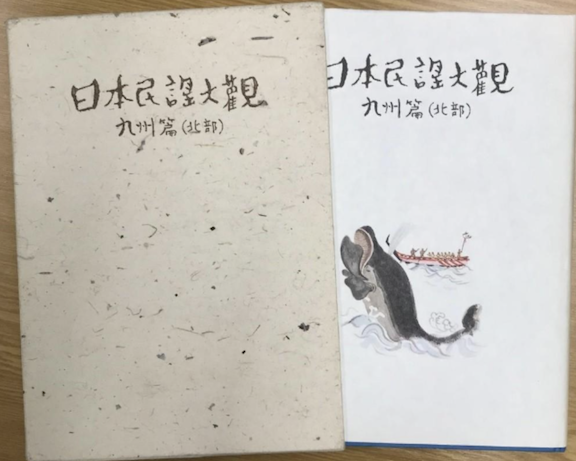
Image of Nihon min’yō taikan : Kyūshū en hokubu by Yoshiaki Machida
Among the collectors was Yoshiaki Machida, also known as Kashō Machida, a shamisen player and ethnomusicologist. Between 1944 and 1980, Machida edited a nine-volume anthology of transcriptions and song notations from different regions in partnership with Japan’s national broadcaster, NHK, which released a set of corresponding recordings. The anthology contains min’yō, which translates literally as ‘folk song’ in Japanese and encompasses a wide variety of traditional Japanese song with distinctive, region-dependent characteristics.
We have one out of the nine volumes in our collection, titled ‘Nihon min’yō taikan : Kyūshū en hokubu’ which translates to: ‘A survey of Japanese folksong : Kyushu district’. Published in 1977 (Showa 52), the book contains regional folk songs from the island ofKyūshū in southern Japan, relating to an assortment of activities – mining, farming, and fishing, and even tea making; there are also lullabies, and songs relating to religious festivals. Housed in a card box covered in textured washi paper, the book features a painted illustration of traditional whalers on the front cover.
The book opens with a foreword written by Tomokazu Sakamoto, company president of NHK at the time. In it, Sakamoto thanks Machida for his editorial work on the book while paying tribute to his advanced age of 90 years old. Here is a translation of a passage from the foreword:
“We reflect on the past, when folk music continued to thrive in the working life of the population, alongside their daily lives. After the war, many jobs gradually began to mechanise and become more streamlined. Min’yō songs, the cultural heritage of our predecessors’ sweat, toil, and joy, gradually began to disappear. Therefore, it is our duty to preserve them as quickly as we can. Even though we call it ‘preservation’ using one word, this does not stop at merely keeping a record of the songs. If we do not understand the path of transmission of these songs, within their real context, it will be almost impossible to fulfil our goal.”
Although a lot of the folk music-related items we hold in our collection relate to British traditions, we also hold a rich variety of music books from around the world, which wouldn’t otherwise be accessible in the UK. Thanks to a generous donation, ‘Nihon min’yō taikan’ is one such item.
